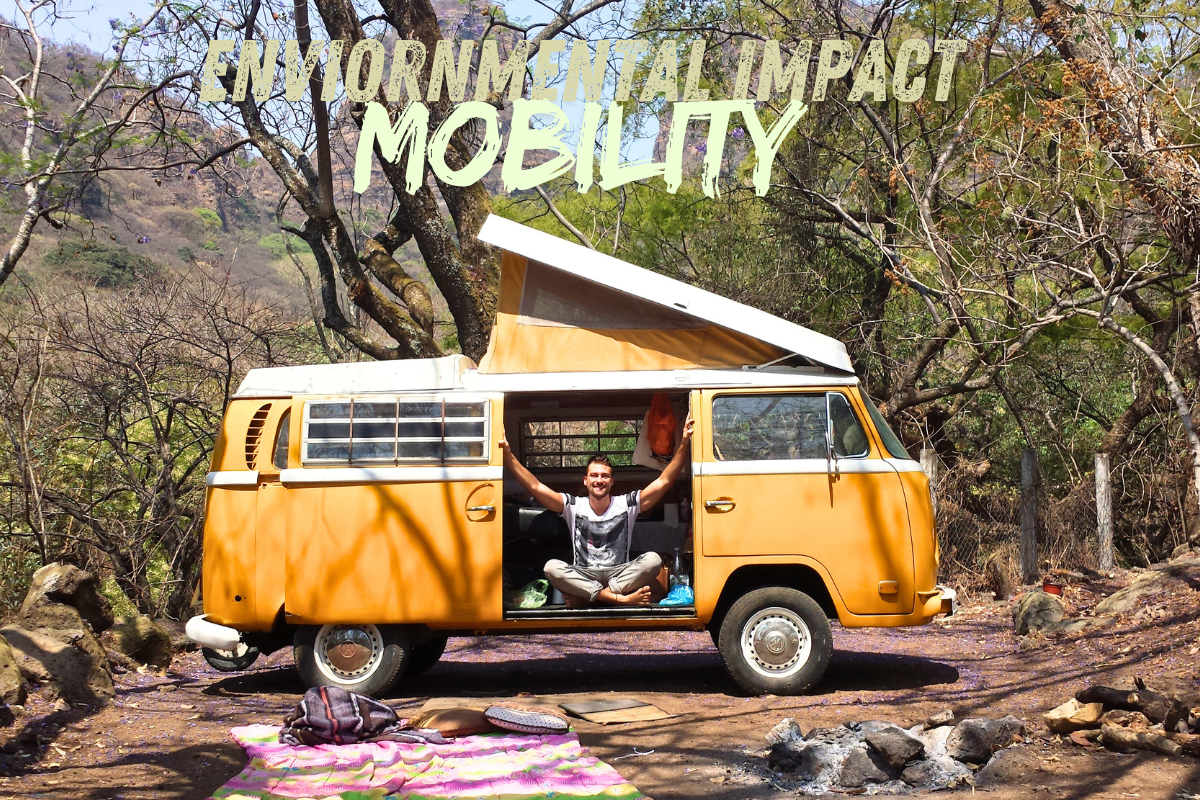

Over 46,000 kilometers across three continents, almost entirely without flying — and what the carbon footprint data actually says
Table of Contents
1. A Transamerican journey Inside a travel once around the world without flying
Over the course of the year 2025, I covered approximately 46,500 kilometers across South, Central, and North America. The majority of this distance was traveled via existing transport infrastructure — primarily long-distance buses and trains — complemented by lower-impact modes such as hitchhiking (around 15,000 km), sailing, cycling, kayaking, and hiking.
Based on the collected activity data and corresponding emission factors, the total estimated footprint for 2025 amounts to 9.5 t CO₂e.
This number is meaningful, but it requires context. Current estimates place the average annual carbon footprint of a resident in Germany at roughly 10–11 t CO₂e. Despite the unusually high travel distance and complex logistics involved, the footprint of this expedition remains slightly below that benchmark. In many conventional travel scenarios, long-haul flights alone can exceed several tonnes of CO₂e per short-trip.
At the same time, the comparison should not be overstretched. The footprint recorded here represents a significant increase compared to the previous year, effectively doubling the total emissions. This reflects both the scale of movement across continents and the cumulative effect of sustained travel over long distances.
Taken together, the data highlights a central tension: even when optimizing for lower-impact mobility and slower travel, covering large distances inevitably carries a measurable environmental cost. In quantitative terms, it is possible to end up within the same annual emissions range as a relatively stationary lifestyle. What this framing does not capture, however, are qualitative dimensions such as experience, perspective, or cultural exchange — factors that are not reflected in CO₂e metrics but remain central to how we evaluate travel and its broader value.

2.From the Atlantic to Brazil: Starting 2025 at Sea
The year began on a sailing boat, crossing the Atlantic from Cape Verde to mainland Brazil. Wind-powered travel set the tone early — partly by choice, partly by necessity, as the engine broke right at the start.
Slow, unpredictable, and extremely low on emissions, the crossing embodied the core logic of the expedition.
From Brazil’s coast, I moved south toward Rio de Janeiro using public transport, where I stayed for about six weeks. Carnival, friendships, and a rare pause in movement made this one of the few stable phases of the year.
Then things shifted. I was robbed, lost my credit cards and money, and for reasons I can’t share yet, had to leave Brazil abruptly. The expedition continued, just under very different conditions.

3. Hitchhiking South: Patagonia, Ruta 3, and Survival travel Mode
With almost no money left, I headed to Buenos Aires and immediately started hitchhiking south along Ruta 3 toward Ushuaia. The journey took about two weeks.
I traveled with truck drivers, families, fellow Brazilian hitchhikers who quickly became friends — and for a short stretch in Patagonia, even with a horse, which remains undefeated in terms of carbon efficiency.
Accommodation was mostly sleeping outside, or wherever people offered help.
Food often came from shared meals with my hitchhiking buddies, leftovers from restaurants, or gas stations.
Emissions were low during this phase, not because of planning, but because survival tends to be resource-efficient by default.

4. Travel from Antarctica and the Long Way North to Alaska
In Ushuaia, I was unexpectedly offered a place on a citizen-science expedition ship to Antarctica, focused on whale watching, education, and research, including continental landings. I joined as a videographer and collaborator, documenting parts of the journey.
With Sea Shepherd operating in the region at the same time, I supported their efforts against industrial krill supertrawlers threatening one of the planet’s most fragile ecosystems. I celebrated my birthday in Antarctica — not planned, but unforgettable.
After returning to the southernmost city in the world, I paused alone in a cabin and in a tent in the mountains for about one month to recalibrate after more than 15 months of continuous movement.
Then I went north again:
hitchhiking to Bolivia, biking across the Salar de Uyuni, entering the Amazon on a survival-style trip with a friend and indigenous companions, and eventually pushing toward the Darién Gap in between Colombia and Panama, using a series of night buses to cover distance efficiently when time and energy were running low.
5. Alaska, System Limits, and the Flight That Put Things in Perspective
After living with the indiginoeus Kuna on the San Blas Island, I bought a Kayak and set out on the open sea to get to the Mainland, but a storm hit me, and after stranding on a lonely island, I had to abort this mission and come back to the Kunda, which gave me a lift back to the Mainland a week after. From Panama, I continued north mostly by hitchhiking and night buses. I skipped some countries along the way — not out of disinterest, but because people were waiting for me in the US.
I hitchhiked from Cancún to Tijuana very adventurous, entered the United States, and was picked up by friends in an RV to attend Burning Man. After the festival, I couchsurfed in Lake Tahoe and San Francisco, climbed in Yosemite (a lifelong dream), and traveled north by Amtrak train (also a lifelong dream).
A road trip through the US and Canada to Alaska with a good friend followed, sleeping in the car, roadside pullouts, and open campsites. In Alaska, I volunteered at a non-profit husky kennel, living off grid in my own cabin without electricity for almost 2 months.
The plan was to cross the Pacific by sailboat in early 2026 and, before that, to film a once-in-a-lifetime documentary with the Rarámuri indigenous communities of northern Mexico.
But reality intervened.
Winter Ferries, my only getaway to the US, were canceled due to broken generators (ironically not meeting emission standards themselves) and subsidy cuts under the Trump administration. Re-entry into Canada was impossible after earlier deportation and flagging in the same year. Winter closed in.
For the first time since the expedition began, there was no low-carbon exit left.
So yes — at the end of 2025, I took one unavoidable flight from Alaska.
From a carbon accounting perspective, that single decision outweighed months of hitchhiking, biking, night buses, and sleeping outside.
The data shows this clearly.

6. 2025 in Numbers: What the Carbon Footprint Data of my travel once around the world without flying reveals
- Total distance traveled: 46,500 km
- Total emissions (all categories): 9.5 t CO₂e
To understand what 9.5t CO₂e and 46,500 km mean in real-world terms, it helps to compare with average lifestyles.
Average German CO₂ footprint:
According to the German Federal Environment Agency and related estimates, the typical per-person carbon footprint in Germany is about 10.5 tonnes CO₂-equivalent per year when all major life domains (housing, mobility, food, goods) are included.
Typical mobility distances:
While national mobility data vary by source, the average annual distance traveled per person in Germany (including commuting, leisure, and other trips) is on the order of 10,000–15,000 km per year — far below the 46,500 km covered here. Public transport, passenger car use, and flights typically contribute heavily to those totals.
What this comparison reveals:
- The 2025 expedition covered roughly three times the annual travel distance of an average German resident — including just one flight at the very end.
- Yet the total CO₂ footprint for the whole year was a bit lower than what many industrialized-country residents produce in a typical year that includes flight travel and conventional consumption patterns.
This doesn’t suggest that long-distance travel is “good for the climate.” Rather, it shows the relative impact of travel mode choice and lifestyle patterns on carbon use:
- Long journeys without flying can lower emissions per kilometer compared to conventional patterns dominated by car and air travel.
- Structural factors (infrastructure, systemic problems/lack of alternatives, policies) remain the most persistent drivers of when and how carbon reductions are possible.
- Main drivers:
- Long-distance mobility, especially that one flight
- Food could see some improvement in 2026
- Key mitigations:
- Extensive hitchhiking (10,000+ km, near-zero emissions)
- Wild camping, couchsurfing, night buses
- Long off-grid volunteer phases
Considering the total distance traveled in 2025, the data reveals how much an individual carbon footprint can be reduced through slow, non-flight travel. Even across continents, emissions remained comparatively low per kilometer — until systemic limits ultimately set the boundary, and my personal choice to move on instead of spending the Winter until April in Alaska,